Early Signs Your Basement Is About to Leak (Before You See Water)
If you discover a leak in your basement, the most important thing is not to ignore the early warning signs but to act quickly: start by clearing the area, lifting any carpets or stored items off the floor, and looking for typical moisture indicators such as damp patches, musty smells, peeling paint or white, powdery efflorescence on the walls or slab. Next, try to note when the leak occurs (for example, only after heavy rain) and where the water seems to be entering, as this helps distinguish between groundwater seepage, poor drainage around the foundation or a plumbing issue. In Auckland, the best move is then to book a specialist basement leak inspection so an experienced waterproofing contractor can identify the root cause and recommend a targeted repair strategy, whether that is sealing cracks, improving drainage or installing a proper waterproofing system to prevent small warning signs from turning into major structural and mould problems.
- Early Signs Your Basement Is About to Leak (Before You See Water)
- How Water Finds Its Way Into Auckland Basements: What the Warning Signs Tell You
- Why These Early Signs Matter for Your Basement's Long-Term Health
- What to Do When You Spot Early Warning Signs: A Structured Response
- Key Takeaway: Act on Early Signs Before They Become Major Problems
Early Signs Your Basement Is About to Leak (Before You See Water)
Auckland basements rarely go from bone‑dry to flooded overnight. In most homes there are subtle warning signs that appear weeks or even months before water actually pools on the floor. Catching those early signs can save thousands of dollars in repairs, damaged belongings, and the stress of dealing with mould and insurance claims.
This guide explains the most common early signs a basement is about to leak, what each one reveals about the moisture pressure building against your structure, and what immediate steps to take. The goal is simple: give you a clear diagnostic checklist so you can act before a minor issue becomes a full‑blown waterproofing failure.
How Water Finds Its Way Into Auckland Basements: What the Warning Signs Tell You
Before understanding the symptoms, it helps to recognise how water pressure builds in Auckland’s unique geology. This context explains why each warning sign matters—they’re not random dampness issues, they’re your basement’s distress signals showing you water is actively working against your structure.
Three pathways water takes to pressure your basement:
Hydrostatic pressure pushing through concrete
Auckland’s clay-rich soils and high rainfall create constant moisture saturation around basement walls. This water weight creates genuine pressure—measured in kilograms per square metre—that forces moisture through microscopic pores, hairline cracks, and construction joints in concrete. Unlike surface water that comes and goes, hydrostatic pressure is relentless after rain.
Surface runoff overwhelming your drainage
When gutters block, downpipes misdirect water, or grading slopes toward your foundation, water pools against external basement walls faster than the surrounding soil can absorb it. This temporary but intense pressure is why early signs often worsen immediately after heavy Auckland storms.
Failed or missing waterproofing protection
Older Auckland homes often lack proper external membrane systems. Even newer homes can suffer membrane failure from UV degradation, installation defects, or settling cracks. Without this protection, even modest hydrostatic pressure finds its way through.
Why this matters for the warning signs below: Each symptom you’ll read reflects one of these three pressure scenarios. When you spot a sign, you’re literally seeing water in motion—either already inside your basement or pressing hard against the structure waiting for a crack to widen.
Sign 1: Musty Odours with No Visible Damp — Your First Alarm
One of the first warnings is a persistent musty or “earthy” smell that lingers in the basement even when surfaces appear bone dry. This smell usually comes from mould spores and microbial activity starting in hidden areas—behind wall linings, under carpet, or deep inside insulation where you can’t see.
What’s actually happening:
In Auckland’s humid climate, even small increases in moisture can tip a marginal space into mould-friendly conditions. The smell you’re detecting means moisture has already migrated into your basement environment—likely for weeks or months. This isn’t surface condensation; it’s evidence that your structure is absorbing water from outside.
The diagnostic clue:
If the smell is stronger after heavy rain or when you first open the door to the basement, treat it as a serious early warning rather than something to mask with air fresheners. You’re smelling your basement’s moisture load increasing in response to Auckland’s weather patterns. This is the moment to act—before that moisture spreads deeper into insulation and timber.

Sign 2: Localised Damp Spots or Cold Patches on Walls — Tracing the Water Path
Run your hand slowly over the lower parts of the basement walls, especially in corners and along construction joints. You may notice small areas that feel cooler, slightly clammy, or just different from the rest of the wall. These spots often appear before visible staining or discolouration.
What is happening behind the scenes:
Moisture is moving through the wall from outside to inside. As water evaporates from the inner surface, it cools that spot slightly—creating a perceptible temperature difference. Over time, these “cold patches” are where efflorescence, paint damage, or visible darkening will eventually appear. You’re seeing the problem in its earliest stage.
The diagnostic clue:
If you can, mark the edges of the affected area with painter’s tape and check again after the next significant rain. Growth in size is a strong indicator of incoming water pressure rather than simple condensation or humidity. If the patch stays the same size, it’s likely surface condensation. If it expands, hydrostatic pressure is increasing.
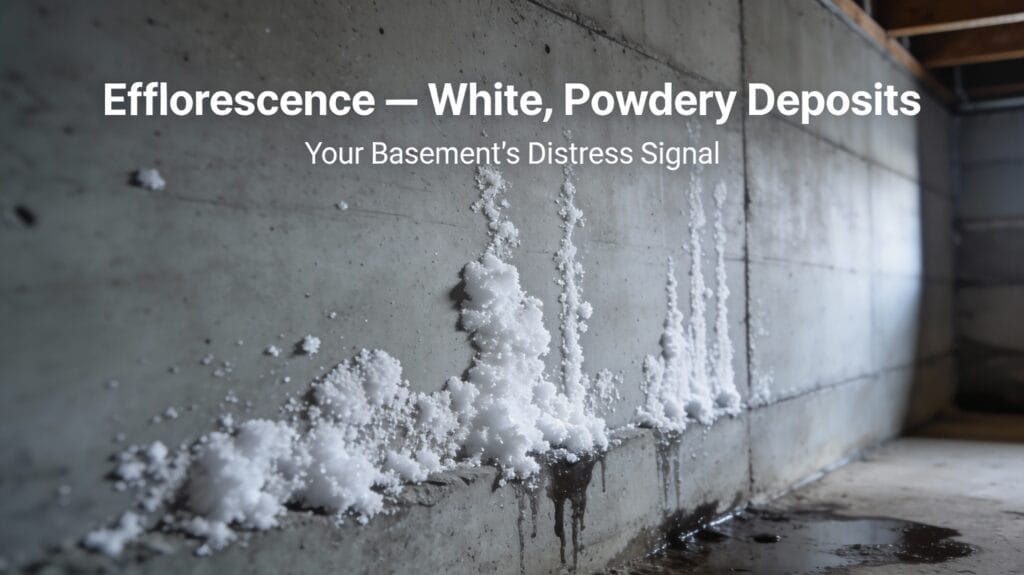
Sign 3: Efflorescence — White, Powdery Deposits (Your Basement’s Distress Signal)
Efflorescence looks like a white, chalky, or fluffy deposit on concrete, blockwork, or mortar joints. It forms when water moves through the wall, dissolving mineral salts in the concrete, then evaporates on the inner face and leaves those salts behind as a crusty deposit.
Why this matters:
On its own, efflorescence is not structurally dangerous, but it is a very clear, visible sign that moisture is actively passing through the wall right now. Think of it as your basement’s distress signal—it’s saying “Water is moving through me under pressure.” Repeated cycles of wetting and drying can also contribute to surface degradation, spalling, and eventual cracking.
In a partly finished basement, efflorescence may appear:
- Along mortar joints in concrete block walls (where water takes the path of least resistance)
- Around hairline cracks or tie-rod holes in poured concrete (concentrated pressure points)
- At the base of walls where they meet the slab (the most common weak point in Auckland basements)
The diagnostic clue:
Many homeowners try to brush or wash efflorescence away without addressing the underlying moisture. If it keeps returning within weeks, it’s telling you the basement is under active water pressure and is at real risk of a full leak. Document how quickly it returns; this pace tells a waterproofing professional how severe the hydrostatic load is.
Sign 4: Hairline Cracks in Walls or Floor — Pressure Points in Your Concrete
Concrete cracks for many reasons—shrinkage, minor settlement, temperature stress—and not all cracks mean a leak is guaranteed. However, certain crack patterns and locations deserve attention as early leak indicators because they reveal where water pressure is concentrating.
Cracks of concern include:
- Vertical or diagonal cracks that widen towards the base of the wall, particularly on the downhill or “wet” side of the house. These show structural stress from water pressure pushing against the wall.
- Cracks that feel damp after rain or show darker edges compared to surrounding concrete. Darker edges mean water has travelled through the crack; damp cracks mean active moisture flow.
- Floor cracks that appear along construction joints or around service penetrations, especially on older slabs without modern waterproofing underlay. These are natural weak points where pressure concentrates.
Why this matters:
In Auckland’s environment, even hairline cracks can allow a surprising amount of moisture through under hydrostatic pressure. A 0.2mm crack might seem insignificant, but when subjected to water pressure after heavy rain, it becomes a pathway. Sealing cracks from the inside alone rarely solves the root cause because the pressure is still there on the outside. However, identifying them early helps a waterproofing professional design the right repair before the surrounding area deteriorates further.
The diagnostic clue:
Map the location and direction of cracks in your basement. If they cluster on one wall (typically the downhill or most exposed side), that’s where water pressure is highest and where problems will first become severe.
Sign 5: Peeling Paint, Blistering, or Bubbling Finishes — Vapour Pressure Building Behind Coatings
Paint and other coatings on basement walls are often the first casualties of hidden moisture. Water moving from the outside to the inside wall face builds up vapour pressure behind the paint layer. The coating traps moisture inside, forcing it to escape by pushing the paint away from the concrete.
Typical symptoms:
- Bubbles or blisters in painted surfaces at the lower half of walls (where moisture concentration is highest)
- Flaking or peeling in vertical “streaks” that follow hidden cracks or block cores (showing where water is finding pathways)
- Soft, crumbly plaster or gib at the base of the wall lining (indicating prolonged moisture exposure)
Why this matters:
Paint failure isn’t cosmetic—it’s your first visual proof that moisture has reached the inside surface of your wall. Simply scraping and repainting will not hold for long if moisture is still moving through the wall. The moisture will build pressure again and lift the new paint within months.
The diagnostic clue:
Peeling paint in vertical streaks acts like a moisture map. Those streaks show where the main water pathways are within the concrete. Use this pattern to pinpoint problem areas for professional assessment.
Sign 6: Rusting Metal, Nails, or Brackets — Corrosion as a Moisture Indicator
Metal elements in a basement—such as framing fixings, shelving brackets, or steel supports—react quickly to sustained dampness. Rust marks around metal fixings close to the floor or near external walls can indicate high humidity or direct moisture contact.
Look for:
- Rust streaks running down from nails or screws in bottom plates
- Corrosion on metal shelving legs sitting on the slab
- Rust on exposed reinforcing bars or steel beams near external walls
Why this matters:
Rust doesn’t appear overnight. It indicates prolonged exposure to elevated moisture levels—not just a one‑off spill or temporary condensation. In combination with other signs like musty odours or efflorescence, rust strengthens the case that the space is trending towards active leakage rather than benign dampness.
The diagnostic clue:
Check the age of the rust. Fresh rust means moisture levels have recently increased; older, layered rust means the problem has been present for months.
Sign 7: Warped Skirting Boards and Swollen Timber — Structural Timber Under Stress
Timber reacts strongly to moisture by swelling, warping, and eventually rotting. Skirting boards and bottom plates in basements sit at the moisture “front line” and often show distress before the rest of the space deteriorates.
Warning signs include:
- Skirting boards pulling away from the wall or curving outward (the wood is expanding)
- Paint cracking along the top edge of skirting where it has moved (visible proof of movement)
- Soft or spongy timber at the base when pressed with a screwdriver (decay has begun)
Why this matters:
This kind of damage indicates prolonged exposure to elevated moisture levels, not a one‑off spill. Timber doesn’t warp from brief exposure to damp air; it warps from weeks of moisture absorption. If you see it along an external wall, the basement moisture problem has been building for some time and needs urgent assessment.
The diagnostic clue:
Timber damage severity tells you how long moisture has been present. Minor warping = weeks to months of exposure. Soft, crumbly timber = months to years of exposure. The timeline matters for understanding how quickly the problem is progressing.
Sign 8: Increased Condensation That Does Not Respond to Ventilation — Structural Dampness vs. Humidity
Some condensation in a basement is normal, especially on very cold days. However, if you notice condensation:
- Forming frequently on windows, pipes, or cold surfaces
- Persisting even after you increase ventilation or use a dehumidifier
- Appearing mainly along one wall or corner (not evenly distributed)
…it may be a sign that the underlying basement structure is cool and damp because of water outside the wall or under the slab, not because of indoor humidity or lifestyle factors.
Why this matters:
This scenario is common in partially underground basements where one side is fully buried. That side stays colder because it’s in contact with saturated soil. The wall itself becomes a “cold sink” that attracts condensation. Condensation driven by structural dampness is a red flag because it shows that the environment is being controlled by outside water pressure, not just indoor humidity or ventilation. No amount of dehumidifying will solve it.
The diagnostic clue:
If condensation concentrates on one wall, that wall is the problem. Ventilation and dehumidifiers work for ambient humidity; they can’t fight hydrostatic pressure pulling cold, damp air from saturated soil.
Why These Early Signs Matter for Your Basement’s Long-Term Health
Ignoring early moisture symptoms does more than threaten the structure of your basement—it allows mould colonies to establish deep in insulation, wall cavities, and timber framing where they’re invisible but actively reproducing.
The timeline matters:
In week 1–2 of elevated moisture, mould spores begin to settle. By week 4–8, visible colonies may appear. By month 3–6, spores have colonised hidden spaces and are releasing allergens into your air continuously. A basement with early signs that you ignore for six months becomes a health risk—especially if that space is used as a bedroom, home office, or kids’ playroom.
Early detection means you stop the problem when moisture is still mostly confined to the structure, before mould has thoroughly colonised your home’s air.
What to Do When You Spot Early Warning Signs: A Structured Response
If one or more of these signs look familiar, take a structured approach rather than quick cosmetic fixes.
Step 1: Document Everything
Take clear photos of affected areas, including close‑ups and wider context shots. Note the date, recent weather conditions, and whether symptoms worsen after heavy rain. This documentation is invaluable for a waterproofing professional—it shows them patterns over time and helps them understand how severe the hydrostatic pressure is.
Step 2: Check External Drainage (Within 24 Hours)
Inspect gutters, downpipes, and surface drains for blockages or misdirection. Look for areas where water pools against foundation or retaining walls. Clearing a blocked gutter costs $150–300 and can immediately reduce pressure on your basement. This is the cheapest diagnostic step you can take.
Step 3: Avoid Trapping More Moisture
Move furniture and storage away from affected walls to allow airflow. Avoid adding more vapour-tight finishes (like vinyl wallpaper or heavy plastic underlay) over problem areas—these trap moisture and accelerate decay. Even temporary measures like cracking a window or running a fan improve conditions while you plan next steps.
Step 4: Call a Qualified Waterproofing Specialist
Share your photos and notes so they can see patterns over time. Ask specifically for advice on both external waterproofing options and internal remediation choices. A professional assessment can determine whether the issue is minor and localised (manageable with targeted work) or a symptom of a broader failure in the original waterproofing system or drainage design.
What a professional will do:
They’ll assess which of the three water pathways is the primary problem (hydrostatic pressure, surface runoff, or membrane failure), recommend whether internal work alone is sufficient or external waterproofing is necessary, and provide a timeline showing when action is most urgent.
Caught these signs early? Our basement renovations guide explains the professional assessment and waterproofing process.
Key Takeaway: Act on Early Signs Before They Become Major Problems
Every early sign in this guide—from musty smells to efflorescence to paint blistering—is your basement telling you water is present and pressurising the structure. None of these signs means your basement is doomed. Early detection is exactly what stops problems from becoming catastrophes.
Auckland’s climate and geology create constant moisture pressure on basements. The homes that stay dry longest are those where owners recognise these early signals and act promptly. By learning to spot them and responding quickly, you avoid the disruption of full‑scale remedial waterproofing and keep valuable below‑ground spaces comfortable, healthy, and functional.
Ready for the next step? If you’ve identified early signs in your basement, learn about basement waterproofing solutions and basement renovation planning to understand your remediation options.

Need it fixed for good? See our basement waterproofing with HydrEpoxy service in Auckland.