Recoat or replace? When membrane replacement needs a building consent
Deck and flat-roof membranes, the Schedule 1 exemption, and what to check before work starts
If your deck sits over a bedroom or your flat roof is starting to look tired, one of the first questions is whether you need council paperwork. The short answer on membrane replacement building consent: routine maintenance usually doesn’t need one, but replacing a membrane that has failed often does. Here’s how the official guidance draws that line, in plain English.

What the law says about repairs and maintenance
Schedule 1 of the Building Act lists work you can do without a building consent. Exemption 1 covers general repair, maintenance and replacement. MBIE’s guidance on exemption 1.1 explains that you can repair and maintain a building using comparable materials, and replace a component with a comparable one in the same position.
There’s an important exception. The exemption does not include the repair or replacement (other than maintenance) of anything that has failed to meet the Building Code’s durability provisions, for example through a failure to meet the external moisture requirements. For decks and roofs, that is exactly the situation where a membrane is leaking.
Recoating a deck membrane: usually maintenance
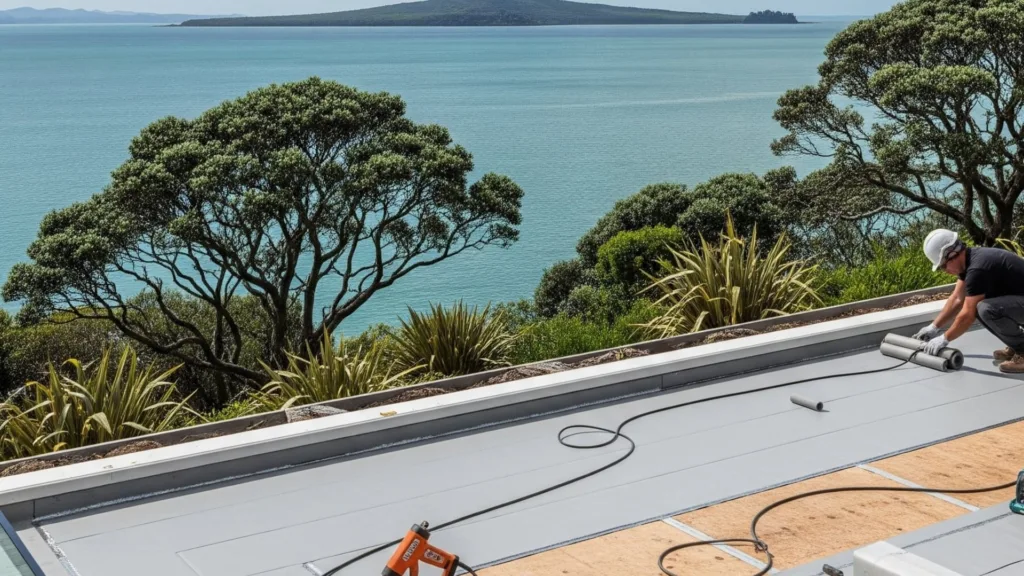
MBIE gives a deck example. If no other building work is needed, maintaining a weatherproofing membrane, such as a fibreglass and painted surface system, on an existing deck that is the roof over a habitable room can be done by applying a new coat in line with the manufacturer’s instructions. That is treated as maintenance.
In practice, that fits the deck in Browns Bay or Mairangi Bay that is still sound but has worn, chalky or faded topcoats. Nothing is leaking, nothing underneath needs fixing, and the same system is being renewed the way the manufacturer intends.
Replacing a failed membrane: often needs consent
It’s different when water is already getting through. MBIE’s own “needs consent” example is wall cladding that failed within 15 years and damaged the framing. The same logic applies to a deck or roof membrane that has failed early. Repairing or replacing it is not just maintenance, so the exemption doesn’t cover it.
On older homes the picture can be different again. MBIE’s exempt examples include replacing roof cladding that has already met its durability requirement (lasted more than 15 years) with a comparable product. Age, cause of failure and the product used all matter, which is why it pays to have someone look before anyone quotes.

Membrane replacement building consent: questions to answer first
- Is the membrane worn, or has it actually failed and let water in?
- Is there damage underneath, such as wet ply, framing or ceiling linings?
- Is the new membrane comparable to the old one, and going in the same position?
- Does the deck or roof sit over a living space?
- Is anything else changing, such as falls, outlets, balustrades or thresholds?
If the answers point to a failure, or you’re simply not sure, MBIE’s advice is to ask your council for a discretionary exemption or apply for a building consent rather than risk applying the exemption wrongly. For most of our clients, that means talking to Auckland Council early.
A government review of exemptions is under way
On 6 October 2026, the Ministry for Regulation announced a review of building consent exemptions, working with MBIE, to see whether more low-risk, minor or routine work could be done without a consent. It is due to report recommendations to Ministers in early 2027. Nothing has changed yet, so today’s rules still apply.
How Auckland Waterproofing Experts approaches membrane jobs
We start by working out why a deck or roof is leaking, not just where. That tells you whether you’re looking at maintenance or a repair that may need consent. We then explain the options and use manufacturer-backed waterproofing membranes for deck waterproofing and roof membranes. If you have an ageing butynol roof, our post on old butynol roof replacement walks through what we look for.
Questions we get about membrane replacement building consent
Do I need a consent to recoat my deck?
Usually not, if it’s genuine maintenance with the same kind of system, no other building work is needed, and you follow the manufacturer’s instructions. MBIE uses a recoated fibreglass deck over a habitable room as an exempt example.
My deck is leaking into the room below. Is that still maintenance?
Probably not. A leak means the membrane may have failed the Building Code’s durability or external moisture requirements, and repairing or replacing it falls outside exemption 1. Check with the council before work starts.
Who decides whether my job is exempt?
The owner is responsible for applying the exemption correctly. If there’s doubt, the council can grant a discretionary exemption, or you can apply for consent.
Not sure whether your membrane job needs a consent?
Tell us about your deck or flat roof and we’ll come and look at what’s actually going on. Call Alex at Auckland Waterproofing Experts on 022 630 6434 for a free site visit. We’ll explain what we find in plain English and send you an itemised quote. You can also read our waterproofing FAQs.
Email aucklandwaterproofing@gmail.com. We’re available 7am to 7pm, Monday to Saturday, based in Castor Bay and working across Auckland and the North Shore.