Building Amendment Bill: what home warranties and proportionate liability could mean for your renovation
A plain-English look at a bill before Parliament, from Auckland Waterproofing Experts
The Building Amendment Bill is a bill, not law yet. It was introduced to Parliament in July 2026. If it passes as introduced, it would change who pays when building work is defective, moving to “proportionate liability”. It would also make home warranties compulsory for new homes and for larger consented renovations that include restricted building work. MBIE expects the liability changes to take effect in 2028. Here’s what the Building Amendment Bill proposes, and what it could mean if you’re planning work on your home.
What is the Building Amendment Bill?
On 2 July 2026, MBIE announced that the Building Amendment Bill had been introduced to Parliament. It’s a package of changes to the Building Act. The main proposals are:
- proportionate liability for defective building work
- compulsory home warranties for new houses, multi-unit homes up to 10 metres high, and larger consented renovations that involve restricted building work
- compulsory professional indemnity insurance for designers such as architects and engineers
- a faster consent pathway, with decisions in 10 working days, for eligible solar-equipped and sustainable homes
- Project Information Memorandum (PIM) processing cut from 20 to 10 working days
- changes to how councils can share building consent services, and to how building research is funded
The bill goes through select committee, where the public can give feedback, before Parliament decides whether to pass it. Details can change along the way.
What is proportionate liability?
Right now, New Zealand uses “joint and several” liability. If several parties are responsible for a defect and one of them can’t pay, another party, often the council and in the end ratepayers, can end up paying more than its share.
Under proportionate liability, each party involved in defective work would only pay for its own contribution to the fault. MBIE says these changes are expected to take effect in 2028, with a one-year lead-in after the bill becomes law.
For homeowners, that means you’d be less able to rely on the council covering the gap if a builder or trade has gone out of business. That’s why the bill pairs proportionate liability with new protections.
Building Amendment Bill home warranties explained
Under the bill, home warranties would be required for:
- all new houses
- multi-unit residential buildings up to 10 metres high
- renovations of $100,000 or more (the threshold set in the bill) that involve restricted building work and need a building consent
According to MBIE, these warranties would cover at least a one-year defect period and a 10-year structural warranty. Warranty providers would need to register with MBIE, meet minimum standards, report to MBIE and publish clear product information.
How this differs from Auckland Waterproofing Experts’ warranties
The home warranty in the bill is a separate, statutory product that would sit over a whole qualifying project. It isn’t the same as the warranties that come with waterproofing work.
On our ARDEX WPM 300 HydrEpoxy basement jobs, for example, there are two separate warranties. ARDEX gives a 10-year product warranty on the membrane, and Auckland Waterproofing Experts give a 5-year workmanship warranty on our installation. Neither of these is a home warranty under the bill, and the bill doesn’t change them.

What the Building Amendment Bill could mean for waterproofing
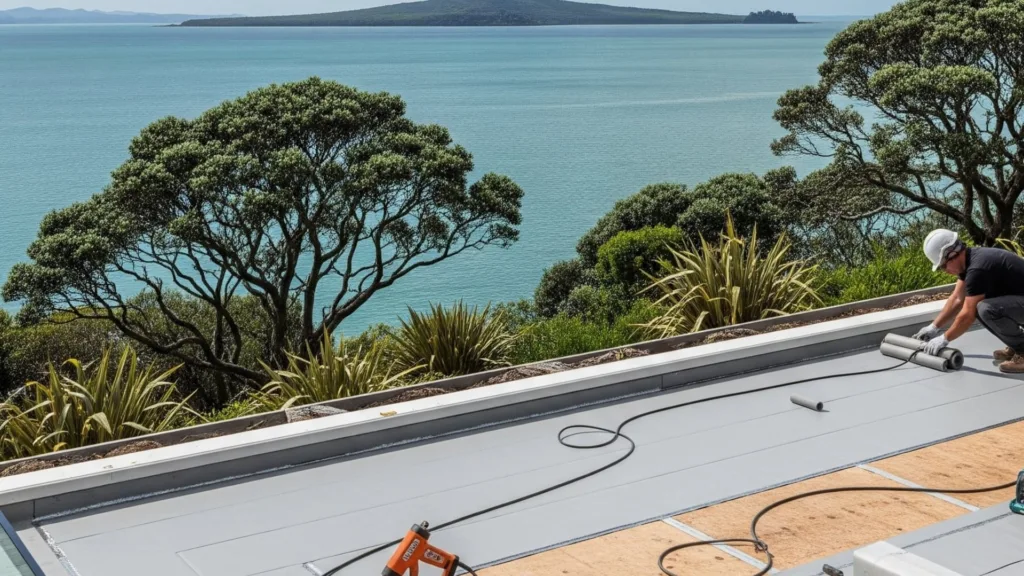
Waterproofing is often part of the work the bill is aimed at. Auckland Council’s guide to booking inspections lists membrane roofs and decks as restricted building work for a Roofing LBP. So a larger consented renovation with a new deck or flat roof could fall within the home warranty rules if the bill passes as drafted.
With each party paying only for its own share of a defect, clear records about who did what become more important. For waterproofing, that means:
- a PS3 producer statement from the applicator, backed by photos and flood or electronic test results
- an LBP record of work for restricted building work
- product and workmanship warranty documents, kept separately and clearly labelled
- a written scope that says exactly which membrane system goes where
Good paperwork has always been worth having. Under proportionate liability, it’s how each party shows what it was responsible for.
What you can do now
- Keep your consent documents, PS3s, records of work and warranties together for every job.
- Use LBPs for restricted building work, and check them on the LBP register.
- Ask each trade, before work starts, which warranties they and the product manufacturer give.
- If you want to have your say, follow the bill’s progress through the link on MBIE’s announcement.
Questions we get about the Building Amendment Bill
Is the Building Amendment Bill law yet?
No. It was introduced in July 2026 and is going through Parliament. It could change before it passes.
When would home warranties start?
MBIE says the liability changes and supporting measures would start after a one-year lead-in once the bill becomes law, and expects the changes to take effect in 2028.
Would my waterproofer’s warranty count as a home warranty?
No. A home warranty under the bill would come from a provider registered with MBIE. Product and workmanship warranties for waterproofing are separate.
Does this change how you work?
Not really. Auckland Waterproofing Experts already photographs each stage, provides a PS3 when a job needs one, and keeps product and workmanship warranties clearly separate.
Planning a renovation that includes waterproofing?
Whether it’s a deck, a flat roof or a basement renovation, call Alex at Auckland Waterproofing Experts on 022 630 6434 for a free site visit. We’ll talk through the waterproofing, the paperwork and the warranties in plain English, then send an itemised quote.
Email aucklandwaterproofing@gmail.com. We’re available 7am to 7pm, Monday to Saturday, based in Castor Bay and working across Auckland.