Water Coming Under Garage Door? Check the Door, the Slab and the Wall
A guide to finding the entry point, by Alex Salikov of Auckland Waterproofing Experts
Water coming under garage door seals after heavy rain is one of the most common calls we get about garages. But the puddle by the door isn’t always coming under the door. In an Auckland garage, water can get in three ways: under the door, up through the slab, or at the joint where the wall meets the slab. Each has a different fix, and often a different trade.
This guide helps you work out which one you have before you spend money on the wrong thing.
Why the entry point matters
A wet patch by the door looks the same whichever way the water arrived. The repair isn’t. Water blowing or running under the door is a surface-water problem, so the answer is usually outside: the driveway, the drainage, or the threshold. Water rising through the slab or seeping in at the base of the wall is a below-ground moisture problem, and that is fixed on the concrete itself.
Get the diagnosis wrong and you can pay for a new door seal when the slab is the problem, or coat a slab when the driveway is sending a sheet of water at the door every time it pours.
Water coming under garage door gaps: three entry paths
Here’s a quick way to sort the three apart. You can check most of it yourself on the next wet day.

- Under the door. The water appears at the door line first, during or straight after rain, and spreads inward. The slab further back stays dry. It often lines up with a driveway that falls towards the garage.
- Up through the slab. Damp patches show up away from the door, sometimes days after rain. Floor coatings bubble or peel, and powdery salt deposits appear on the concrete.
- At the wall-to-slab junction. The wet line runs along the base of a wall, usually one that has soil banked against the outside, as in many under-house and cut-into-the-slope garages on the North Shore.
If the floor itself looks like the source, our guide to water seeping concrete floor walks through simple tests that help tell ground moisture from a plumbing leak.
Path 1: under the door itself
When the water really is coming under the door, the cause is usually one of these:
- The driveway or paving falls towards the garage, so rain runs straight at the opening.
- There’s no water trap, or the door seal has worn, so wind-driven rain gets under the bottom of the door.
- The garage floor sits too close to the level of the paving outside.
- A channel drain across the entrance is blocked, too small, or missing.
BRANZ’s bulletin on timber-framed garages recommends a water trap at the main door: either stop the slab at the door or form a 20–25 mm rebate in the floor for the door to close into, sloped to the outside so any water that gets under the door drains away (BRANZ BU557). The same bulletin notes that E2/AS1 allows a minimum level change of 50 mm between the interior and the exterior paving at the vehicle doorway of an attached garage, and it recommends the finished floor of a garage sits at least 100 mm above the highest adjacent ground.
These fixes belong to other trades, such as a drainlayer, a concrete contractor or a garage door installer. A membrane on the slab won’t stop a river of rainwater running in under the door, so we’ll tell you if that’s what we see.
If water is heading for your garage from further up the section, Auckland Council’s flood maps can show whether an overland flow path runs through. We explain how to read them in overland flow path basement risk.
Path 2: up through the slab
Many older Auckland garage slabs were poured without a damp-proof membrane underneath, or the membrane has been damaged. Ground moisture then moves up through the concrete. You’ll see it as damp patches that don’t line up with the door, coatings that lift, and a floor that never quite dries.
This is where an internal moisture barrier makes sense. We use ARDEX WPM 300 (HydrEpoxy), a two-part water-based epoxy that bonds to damp concrete and is rated for negative-side use, which means it goes on the inside face while the water is pushing from outside. It needs bare concrete, so existing paint or coatings have to be mechanically removed first.
Path 3: where the wall meets the slab
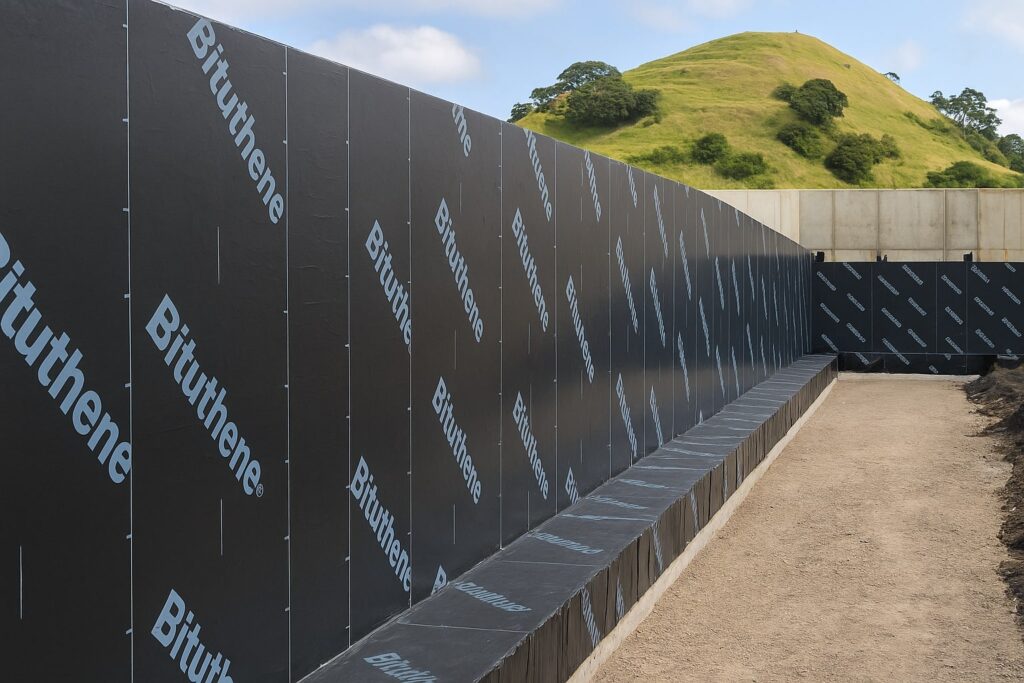
The joint between the bottom of the wall and the slab is a weak point in any garage dug into a slope. Soil against the outside of the wall holds water after rain, and it finds its way through the joint or through the wall itself.
The same HydrEpoxy system can be applied to the inside of the wall and the slab, with corners, joints and small cracks reinforced. Because it goes on from the inside, there’s no digging around the outside of the house.
What to check before you call anyone
- Watch where the water first appears during heavy rain, and take photos with the time on them.
- Tape a square of plastic to the dry slab away from the door for a day or two. Condensation under the plastic points to moisture coming up through the concrete.
- Look at the driveway. Does it fall towards the door? Is there a channel drain, and is it clear?
- Check the door’s bottom seal for gaps, tears or flattening.
- Note whether the wet line follows a wall that has soil against it outside.
None of this replaces a proper look, but it makes the site visit quicker and helps you brief the right trade.
How we handle it
Auckland Waterproofing Experts offers a free site visit to work out where the water is coming from. On that visit we check the walls for efflorescence and any active leaks. The weakest point is usually where the wall meets the floor. We also check the outside, because if there’s no external membrane on the wall there may well be issues inside. On a block wall we look for efflorescence marks. If Gib board, lining or skirting is fitted, we check whether it’s swollen or shows mould, efflorescence or dampness. We have a basic moisture meter, but the problem is usually obvious, so it’s rarely needed. If the water is coming through the slab or the base of the wall, you’ll get a quote that is always free, written and itemised. If the water is coming under the door, we’ll say so and suggest which trade to talk to. You can read more about the HydrEpoxy system on our garage waterproofing auckland page. An ARDEX warranty is available where applicable. When the work is done, you get product and workmanship warranties where applicable, and photos of the work. If the job is consented through Auckland Council, you also get a PS3.
Find the path before you fix it
Water coming under the garage door can be a door, driveway or drainage problem, or it can be the slab or the wall, so find the entry path first and then choose the fix.
You can also read our waterproofing FAQs.