Waterproofing Membrane for Plywood Deck Builds: How to Choose
A guide to choosing a deck membrane, by Alex Salikov of Auckland Waterproofing Experts
Picking the right waterproofing membrane for plywood deck builds is one of the bigger decisions on a timber-framed deck, especially one built over a bedroom, garage or living room. Several membrane types are used on plywood in New Zealand, and each handles movement, foot traffic and finishes a little differently.
This guide is about choosing the membrane, so you can go into quotes knowing what to ask. It doesn’t cover building the substrate. In short, the plywood has to be prepared to the membrane maker’s spec first, and our guide to substrate preparation covers that side.
Why plywood decks need careful membrane choice
BRANZ describes a waterproof deck as essentially a low-slope roof built to carry foot traffic. Typically, it has timber framing, a plywood substrate and a waterproof membrane, and it may sit over a habitable living space (BRANZ BU583). Because it’s part of the building’s weathertight envelope, it has to meet Building Code clause E2.
BRANZ also notes these decks have had a less-than-satisfactory history, mainly because of poor detailing and construction. Two of the problems it lists are about the membrane itself: a membrane that can’t tolerate regular foot traffic, and joint treatment that doesn’t suit the chosen membrane, which can overstress it along the joints.
Sheet joints and movement
Plywood is laid in sheets, and every joint between sheets is a line where the deck can move a little as the timber takes up and loses moisture and the framing flexes under load. The membrane over those joints has to cope with that movement.

Different membranes deal with the joints in different ways. BRANZ notes that under butyl, EPDM and some liquid-applied systems, the substrate joints are covered with polyethylene tape, so the membrane isn’t bonded right across the joint. Under PVC and some liquid-applied membranes, the joints may be flush stopped instead. Whatever the system, the joint treatment has to be the one its manufacturer specifies.
Deck shape matters too. BRANZ says large decks, or decks that wrap around a corner of the building, may need movement control joints in both the substrate and the membrane.
Waterproofing membrane for plywood deck builds: the common types
These are the membrane types most often used on plywood decks. Each one has to be used as a complete system, with the maker’s primer, adhesive, seam tape and details. We usually recommend TPO: it’s easy to install and easy to control quality, it’s welded, it has at least a 20-year product warranty, and it’s easy to repair later.
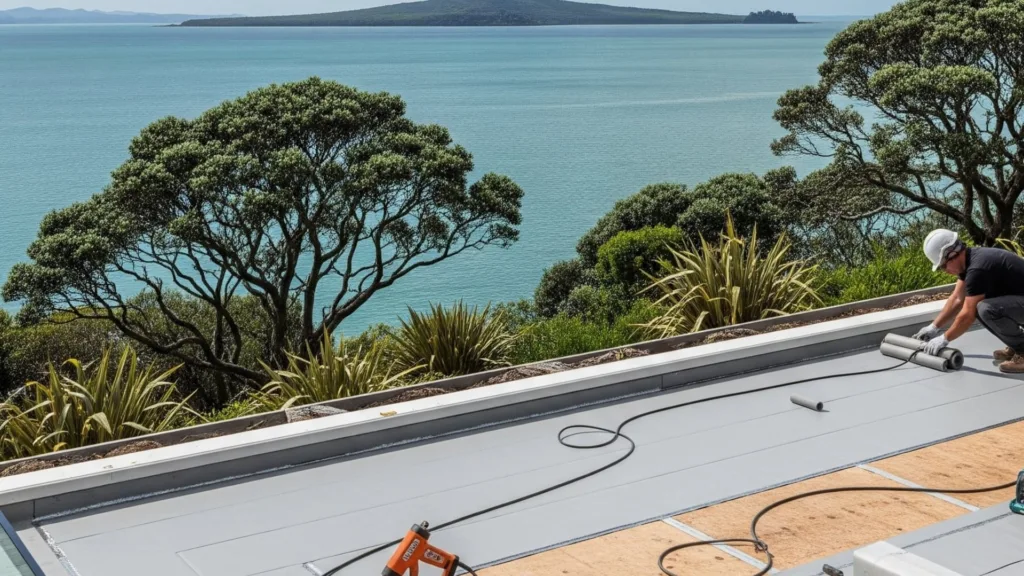
- TPO sheet. Single-ply sheet with heat-welded seams, so the joints are fused rather than glued. This is the system we usually recommend on plywood decks for the reasons above.
- PVC sheet. Another single-ply welded sheet. Some PVC sheets are made specifically as trafficable deck membranes.
- Butyl or EPDM rubber sheet. Flexible synthetic rubber sheets glued to the plywood, with lapped and taped joints. BRANZ’s 2015 bulletin notes these were the only membranes covered by E2/AS1 for walk-on decks at the time.
- Liquid-applied systems. Acrylic or polyurethane membranes rolled or brushed on in coats, often with reinforcing at corners and joints. They’re seamless and handy around awkward details, but only where the system’s appraisal or certificate covers plywood decks.
- Torch-on modified bitumen with a protective wear layer. BRANZ lists this as another option on decks. It’s a heavier, two-layer system.
Sheet and liquid systems each have their place: sheet membranes give you welded or taped joints you can check, while liquids suit awkward shapes where a continuous coat helps. For a fuller side-by-side, see our membrane comparison. BRANZ notes that membranes other than butyl or EPDM have to be consented as an alternative method. That doesn’t make them worse. It means the product’s own evidence has to do the work.
How the deck will be used
The right membrane depends a lot on what the deck has to put up with:
- Light foot traffic only. Most deck membranes are designed for this. Check the system is rated as trafficable, not just as a roof membrane.
- Furniture, barbecues and pot plants. BRANZ warns that unprotected deck membranes can be punctured by sharp objects or point loads such as heels or outdoor furniture. A removable walking surface, such as pavers on pedestals or timber slats on packers, protects the membrane and can be lifted for inspection.
- Tiles. Tiling straight onto the membrane is a different compliance route and needs a membrane system made for it. That’s covered in our separate post on tiled decks.
If the deck is over a living space
A leak through a deck over a bedroom or lounge shows up as damage inside the house, often well after it started. This is where the membrane’s track record and paperwork matter most.
BRANZ describes a typical compliance path for a waterproof deck as comparing the details with E2/AS1 plus, for the membrane, a successful history of use, a durability opinion, a product appraisal or CodeMark certification. Under the Building Code’s durability clause, the membrane needs a minimum durability of 15 years with normal maintenance, and the framing and plywood must last the life of the building, which is not less than 50 years.
Check the appraisal names plywood
This is the single most useful check when comparing quotes. A membrane’s appraisal or CodeMark certificate sets out where it can be used. Make sure it names plywood as a substrate, covers walk-on decks, and suits a deck over a living space if yours is one. Our post on the CodeMark waterproofing membrane explains how certificates and appraisals differ and where to check them.
If a quote names a membrane but the paperwork doesn’t mention plywood decks, ask why before you go any further.
How Auckland Waterproofing Experts can help
We install sheet and liquid membrane systems on plywood and concrete decks across Auckland. We visit the site first and help you choose the system that suits the deck and how you’ll use it — and as above, we usually recommend TPO. Any quote is always free, written and itemised. For substrate and building work we recommend Roy Construction. See our deck waterproofing Auckland page for more on how we work with your builder on the substrate. When the membrane work is done, you get product and workmanship warranties where applicable, and photos of the work. If the job is consented through Auckland Council, you also get a PS3.
Choose the membrane for the deck you have
Choosing a waterproofing membrane for a plywood deck comes down to how the system handles sheet joints, how the deck will be used, what’s underneath, and whether its paperwork clearly covers plywood — with TPO our usual recommendation where it fits.
You can also read our waterproofing FAQs.