Wet Basement NZ Reddit: What Kiwi Homeowners Say About Water Downstairs
A round-up of NZ Reddit threads, by Alex Salikov of Auckland Waterproofing Experts
Wet basement NZ Reddit threads all seem to start the same way: a few days of heavy rain, then a damp patch or wet carpet along the bottom of a downstairs wall. I’m Alex Salikov from Auckland Waterproofing Experts, and I read through six of these threads from r/diynz, r/auckland and r/newzealand. Below is what people keep running into, where they agree, where they argue, and what I’d add from the jobs we do. Everything is summarised in my own words, with a link to each thread so you can read the originals.
What the water looks like in the NZ Reddit threads
The pattern is very consistent. Water doesn’t usually show up after a single shower. It turns up after several days of steady rain, once the ground outside is saturated (house basement leaking, r/diynz). People describe wet carpet right at the base of a wall, paint bubbling or flaking off, and powdery salt deposits (efflorescence) on bare concrete as the water dries out (water through the slab and base of the wall, r/newzealand).
Those details matter. Water that only appears after long rain, low down on a wall with soil behind it, points to ground water pushing through the wall or the wall-floor joint, not a burst pipe or a roof leak.
Check your drains first: gutters, downpipes and ground levels
This is the advice that comes up more than any other, and I think it’s right. Before anyone spends money on the wall, people suggest checking the simple things. Are the gutters clear? Do the downpipes actually discharge into stormwater, or are they dumping water against the house? Is the ground outside higher than the floor inside? In one thread the cause turned out to be a blocked stormwater drain, and in another it was a gap between outdoor paving slabs letting water run straight down the wall (r/diynz).
Others point out that many older NZ homes with rooms below ground were built without proper drainage behind the walls, so a drainlayer is often the first call (who to call when the house gets wet in rain, r/auckland). One homeowner stopped surface water reaching the wall with a trench drain first, and only then sealed the cracks (basement leak advice, r/diynz). If water is running across your section towards the house in heavy rain, read our guide on the overland flow path problem too.
Inside or outside? The argument in every thread
Most commenters say the textbook fix is from the outside: dig down beside the wall, apply a membrane to the outer face, add protection board and a drain coil, and backfill with drainage metal (moist basement, r/diynz). They’re right that this stops water before it reaches the wall. They also say plainly that it’s not a DIY job, especially on a house built into a hill (digging out a basement wall, r/diynz).
A smaller group say an internal system worked for them where digging outside wasn’t possible, for example because of a neighbour’s boundary, a driveway or a steep slope. Usually they paired it with sorting out drainage at ground level.
My honest take sits between the two. If the drains, downpipes and ground levels are the problem, fix those first, because no coating should be asked to hold back water you can easily send somewhere else. Where water is coming through the wall or the wall-floor joint and outside access is impractical, sealing from the inside is a sound option. We did exactly that on a leaking basement wall in Parnell. One thread also suggests waiting through a wet season after drainage work before relining, to see what’s left (r/diynz).
Buying a house with a damp downstairs
A few threads come from buyers looking at a home with a damp semi-basement and trying to work out how big the job really is (r/diynz, r/diynz). The common worry is not knowing whether it’s a gutter fix or a dig-out. The useful advice is to visit after heavy rain, look at the base of the walls and under flooring, check the ground level outside, and get someone to look on site before you commit. If you’re on the other side of the sale, we’ve also written about a damp basement before selling.
Who do you call: drainlayer, builder or waterproofer?
People are often stuck on this (who to call when the house gets wet in rain, r/auckland). The answer in the threads depends on where the water comes from. Water dripping from above is a plumbing or roof question. Water running in from the section is usually a drainlayer job. Water seeping through a below-ground wall or rising at the base of it is where a waterproofer comes in. If the drains check out and water still comes through the wall, that’s when basement leak repair is the job.
What I see on real jobs
We do internal tanking of basements and garages with ARDEX WPM 300 (HydrEpoxy), a moisture barrier made to go on the inside face of the wall and floor.
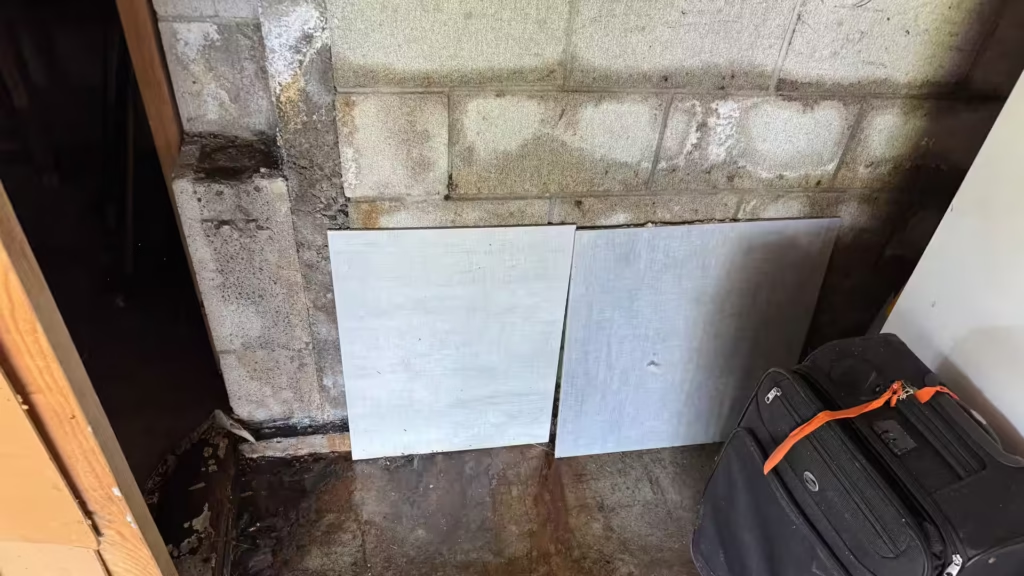
A recent job in Birkenhead is a good example of what the Reddit threads describe. Water was seeping through the base of a concrete block wall and spreading across the floor. We ground the floor back to sound concrete, patched the wall base and formed a cove where the wall meets the floor, then applied ARDEX WPM 300 over around 20 m² of wall and floor, running continuously across that junction.
Quite often, though, drainage turns out to be the real cause. When that’s the case, I send people to a drainlayer first.
If you’re not sure whether your problem is drainage or the wall itself, we offer free site visits. Call 022 630 6434.
The Reddit threads we read
Summarised in our own words above. Opinions in these threads are the posters’ own, not ours, and they don’t endorse us.
- House Basement Leaking (r/diynz, Feb 2024)
- Moist Basement! (r/diynz, Feb 2020)
- Rough cost of digging out basement wall to waterproof? (r/diynz, Apr 2025)
- Basement Leak – Advice Needed (r/diynz, Jul 2025)
- who to call to stop house getting wet during rain? (r/auckland, Jul 2025)
- Water coming through concrete slab/base of wall (r/newzealand, Oct 2024)
Find the source before you choose a fix
The wet basement NZ Reddit threads agree on one thing: find out where the water is coming from before you pick a fix.
You can also read our waterproofing FAQs.